September 10, 2026

The cyber insurance requirements Minnesota financial firms face have changed significantly over the past few years. Carriers no longer take a firm's word that "we have good security" — renewal applications now ask for specific, provable controls, and firms that can't document them are seeing higher premiums, reduced coverage, or outright denial.
This shift matters more for financial advisors and firms handling client financial data than almost any other small business category, since a breach there carries both regulatory exposure and direct financial liability to clients. Here are the seven areas carriers are checking most closely right now, and what "proof" actually needs to look like.
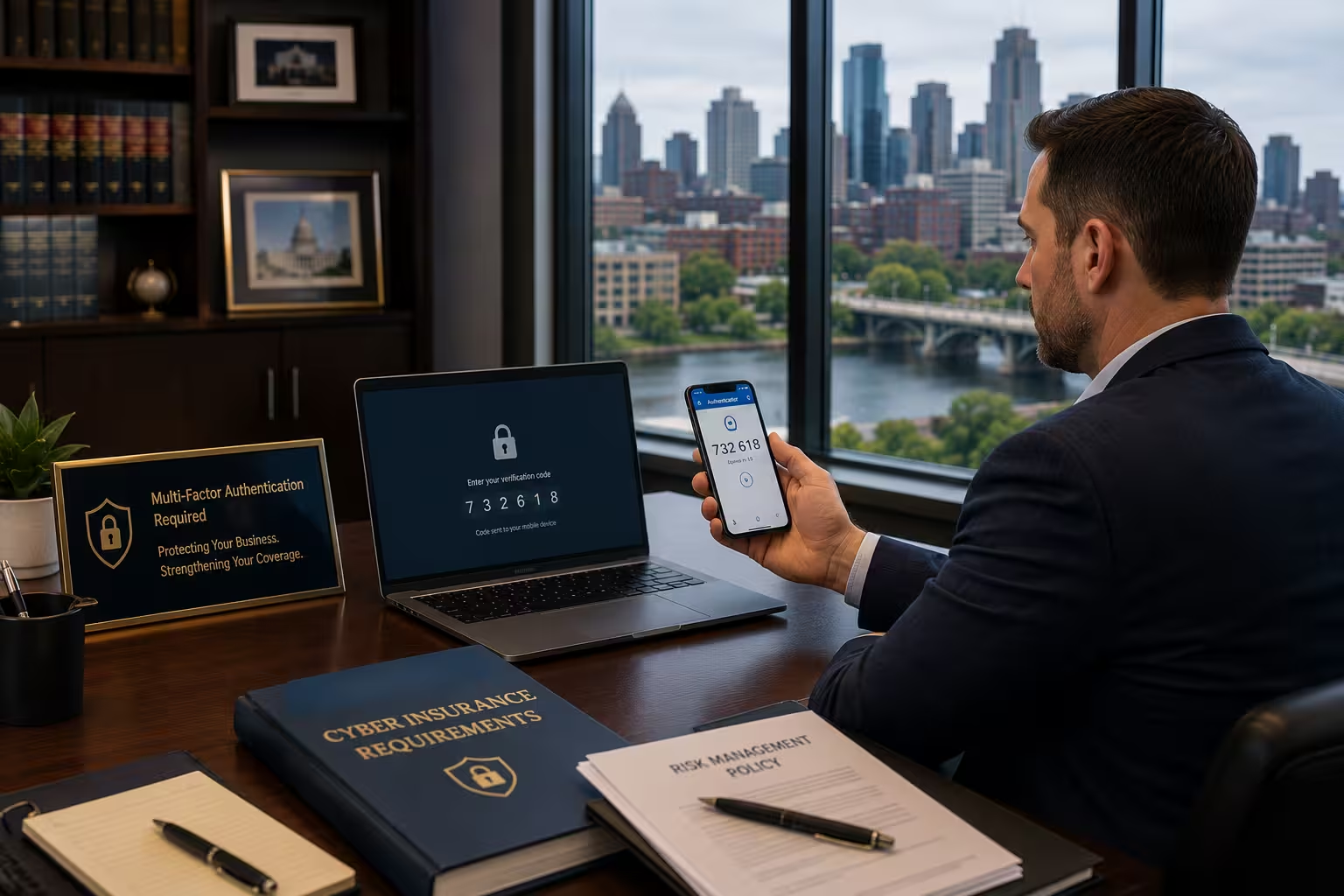
MFA on email alone no longer satisfies most carriers. Current applications typically ask whether MFA is enforced on remote access (VPN), privileged/admin accounts, and any cloud application containing client data — not just the primary email system. Firms need to be able to answer this specifically for each system, not with a general "yes, we use MFA."

Traditional antivirus is increasingly treated as insufficient on its own. Carriers are asking specifically about EDR (endpoint detection and response) — tools that actively monitor and respond to suspicious behavior rather than just matching known virus signatures. This distinction shows up by name on many current applications, so "we have antivirus installed" and "we have EDR" are now different answers.

Ransomware resilience is one of the most heavily weighted factors in current underwriting. Carriers want to know whether backups are immutable (meaning ransomware can't encrypt or delete them even with admin access) and whether restores have actually been tested — not just whether backups run on schedule. Data backup and disaster recovery setups built specifically with this standard in mind are what most current applications are really asking about.
Since phishing remains the most common entry point for a breach, carriers frequently ask whether employees receive regular, documented security awareness training — not a one-time onboarding video, but an ongoing program with records showing who completed it and when.
A plan that exists only informally ("we'd figure it out") doesn't satisfy this requirement. Carriers want a written plan naming specific roles, and increasingly ask whether it's been tested through a tabletop exercise within the past year.
Financial firms relying on cloud platforms, CRM systems, or portfolio management software are increasingly asked to demonstrate that these vendors themselves meet security standards — since a breach through a vendor's system is still a breach of the firm's client data.
Carriers want evidence that systems are patched on a defined schedule and that vulnerabilities are actively scanned for, not discovered after an incident. A documented patch management process is now a standard underwriting question, not an advanced one.
Firms that can't document these controls at renewal time are seeing three outcomes: higher premiums to offset the perceived risk, reduced coverage limits or added exclusions, or non-renewal entirely. For general context on how carriers are approaching this shift, the National Association of Insurance Commissioners' Cybersecurity Resource Center outlines the industry trend toward requiring documented, provable controls rather than self-attestation. The FBI's Internet Crime Complaint Center (IC3) also publishes annual data on the attack trends driving this shift, which is useful context for understanding why carriers are tightening requirements industry-wide.

Most of the cyber insurance requirements Minnesota financial firms are being asked about aren't difficult to implement - the challenge is usually documentation and verification, not the underlying technology. A professional review can confirm exactly which of these seven areas your firm can already prove, and close the gaps in the ones you can't.
Exutory Solutions offers a free $1,500 IT and Cloud Audit for Minneapolis financial services firms, which includes a direct review against current cyber insurance underwriting standards. No cost, no obligation.
Schedule your free IT and Cloud Audit with Exutory Solutions →